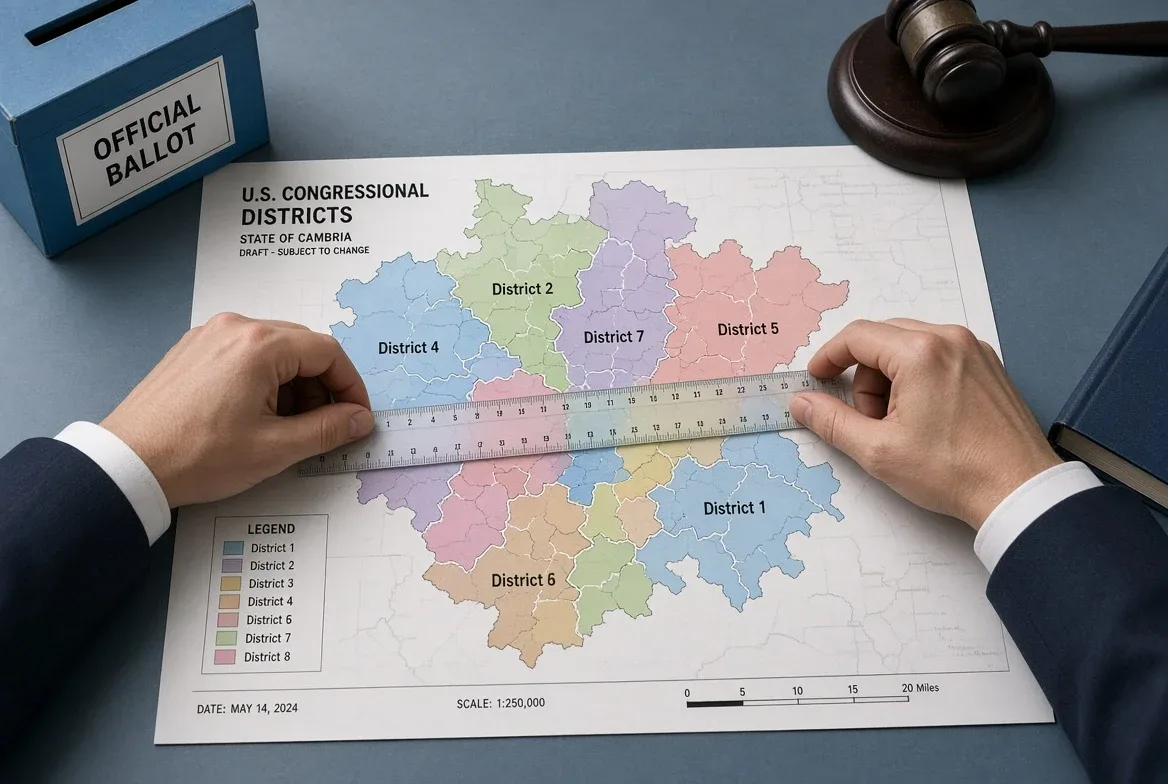
An independent redistricting commission takes the power to draw congressional lines away from the legislature and gives it to a citizen panel selected through an application and lottery process, not an election. Nine states use one for congressional maps, according to Ballotpedia's tracking of post-2020 redistricting structures. In 2025, two of the largest — California and Texas — showed how a legislature can still get its own map drawn, commission or no commission.
How the commission model works. The basic design, pioneered in Arizona and refined in California, replaces legislators with randomly selected citizens bound by party-balance rules. Arizona's five-member Independent Redistricting Commission is built in two steps: legislative leaders in the state Senate and House each pick partisan commissioners — no more than two of the five can share a party registration — and those four partisan members then choose a fifth, unaffiliated commissioner to chair the panel, according to the Arizona Secretary of State's office. The commission convenes once a decade, after the census, and its maps take effect once certified, without a legislative vote.
How does California's commission actually pick its members?
California's 14-member Citizens Redistricting Commission starts from a much larger pool. Nearly 30,000 people applied to serve on the commission that drew districts after the 2010 census; about 25,000 were ruled tentatively eligible, and roughly 5,000 completed a supplemental application, according to the commission's own account of the process. An Applicant Review Panel narrowed that pool to 60 finalists — split evenly into 20 registered Democrats, 20 registered Republicans, and 20 registered with neither major party. Legislative leaders from both chambers and both parties could then strike up to two applicants from each 20-person group, and the state auditor ran a random drawing to select the first eight commissioners from what remained. Those eight had until the end of that year to choose the final six members, filling out the 14-seat panel by the following January 1. The design's core idea is that no elected official picks a majority of the people who will draw their own district.
Why did California bypass its own commission in 2025?
California voters approved Proposition 50 on November 4, 2025, a ballot measure that let the Democratic-led Legislature draw a new congressional map to replace the boundaries the state's independent commission had adopted after the 2020 census, PBS News reported. The new map creates up to five additional districts Democrats could win. The mechanism is legal because California's commission process is a creature of a 2008 and 2010 ballot initiative — and voters can suspend or override a ballot initiative with a subsequent one. A commission's independence lasts only as long as the electorate, or the constitutional structure that created it, doesn't vote to set it aside for a cycle.
What happened with Texas's map, and why does the Supreme Court ruling matter?
Texas has no independent redistricting commission — its congressional map is drawn by the Legislature and governor directly, the model most states still use. After President Trump pushed Texas and other Republican-led states to redraw districts mid-decade, the Legislature adopted a new map that a three-judge federal panel found likely unconstitutional following a nine-day October hearing, citing evidence — including a Justice Department letter and lawmakers' own public statements — that map-drawers had used racial data to eliminate districts where Black and Latino voters formed a majority, according to NPR. On December 4, 2025, the Supreme Court reversed that panel in an unsigned order, ruling the lower court had "failed to honor the presumption of legislative good faith," and cleared Texas to use the map in the 2026 midterms. Justice Elena Kagan dissented, writing the ruling would place "many Texas citizens... in electoral districts because of their race." The redrawn map could hand Republicans up to five additional U.S. House seats.
What's the net effect heading into 2026?
Running the state-by-state changes together — California's projected five Democratic-leaning seats, Texas's five Republican-leaning seats already in place, plus Republican-favoring changes of one seat in Missouri, one in North Carolina, and two in Ohio — points to a net Republican advantage of roughly four seats nationally if the current maps hold through the 2026 midterms, according to PBS News's tally. More states are still moving: Indiana Republicans were weighing redistricting in a December session, Kansas's stalled effort could resurface in its January 12 legislative session, Maryland's Democratic governor announced a new redistricting push, and Illinois, Virginia, and New York have Democratic-led efforts in earlier stages. Litigation is pending in several of these states, so any single map's status can still change before ballots print.
Does a commission actually stop this from happening?
A commission changes who draws the first map after a census, and it can make the drawing process public and rule-bound rather than closed-door. It does not, by itself, block a legislature and a friendly electorate from voting to override it later, or block a legislature that never had a commission from redrawing lines between censuses if courts allow it. The commission model's durability rests on the same mechanism that created it — a constitutional amendment or ballot initiative is harder to reverse than an ordinary statute, but it is not impossible to reverse, as California's 2025 vote showed.
For a related policy news perspective, read A Game-Changing Platform for Independent Writers.