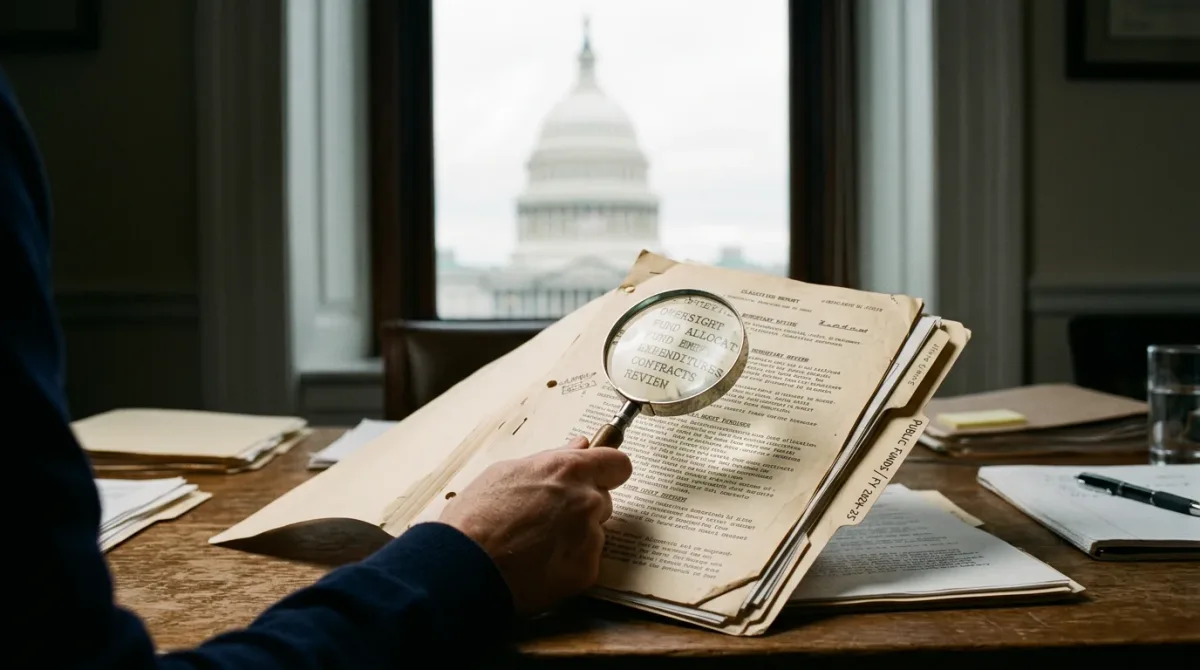
A federal inspector general is an independent watchdog placed inside a government agency to audit and investigate that agency's own programs. Inspectors general do not run programs and cannot set agency policy. They publish findings and recommendations, and the agency decides what to do next. That division of labor, described here as of August 2026, is the whole mechanism.
What does an inspector general actually do?
Federal law directs each inspector general (IG) to conduct, supervise, and coordinate audits and investigations of the agency's programs and operations, and to recommend policies that promote economy and efficiency or that prevent and detect fraud and abuse. The same section requires IGs to review legislation affecting the agency and to coordinate with other bodies on fraud detection (5 U.S.C. § 404).
The most consequential duty is a reporting duty. The statute tells each IG to keep the head of the agency and Congress "fully and currently informed" about fraud and other serious problems, abuses, and deficiencies. An IG who finds something is not free to keep it inside the building.
The Council of the Inspectors General on Integrity and Efficiency (CIGIE), the umbrella body for the IG community, describes the work as audits, investigations, and inspections. Audits test whether money and programs were managed properly. Investigations pursue specific suspected fraud or misconduct. Inspections and evaluations sit between the two, examining how a program is actually running.
An IG office does not prosecute. Criminal matters are referred to prosecutors, who decide independently whether to bring a case.
Who appoints an inspector general?
It depends on the agency. At Cabinet-level departments and major agencies, the President nominates the inspector general and the Senate confirms the appointment, according to CIGIE's public guidance for the IG community. Smaller federal entities have their own IG offices established under the same body of law.
The arrangement is deliberately awkward. The IG sits inside the agency, is funded through it, and reports to its head — while also reporting independently to Congress. That tension is the design rather than a defect in it, and it is why the reporting deadlines below are written into statute instead of left to agency discretion.
What happens after an IG finds a problem?
Most findings travel through a scheduled reporting cycle, not a press conference. Each IG must prepare a report summarizing the office's work twice a year and give it to the agency head no later than April 30 and October 31, covering the preceding six-month periods. The agency head then has 30 days to transmit it to Congress.
The law specifies what those semiannual reports must contain: a description of significant problems, abuses, and deficiencies; recommendations for corrective action; an identification of unresolved significant recommendations; a summary of prosecutions and referrals; a listing of audit, inspection, and evaluation reports with the dollar value of questioned costs; and statistical tables on management decisions and final actions (5 U.S.C. § 405).
The "unresolved" category is the part that does the accountability work over time. A recommendation the agency has not acted on does not quietly expire. It reappears in the next report, and the next one, until it is closed.
Within 60 days of a semiannual report being transmitted to Congress, the agency must make copies available to the public on request, at reasonable cost.
What if the problem cannot wait six months?
There is a fast lane. When an IG becomes aware of "particularly serious or flagrant problems, abuses, or deficiencies" in the agency's programs and operations, the law requires an immediate report to the agency head. The agency head must forward it to the appropriate committees or subcommittees of Congress within seven calendar days, together with whatever comments the agency wants to attach.
Two features of that rule matter to a reader trying to follow a story. The clock is short and it is statutory, not customary. And the agency's own response travels with the finding, so Congress sees the disagreement, where there is one, at the same moment it sees the finding.
Where can you read the reports yourself?
Oversight.gov is, in CIGIE's own description, "the one-stop shop for all public reports from federal Offices of Inspector General that are members of" the council. Roughly 75 federal OIGs participate, from AmeriCorps to the U.S. Postal Service. In 2023 CIGIE merged the original site, launched in 2017, with IGnet.gov into a single public repository of IG reports.
Individual OIGs also publish on their own websites, and each runs a hotline for reporting suspected fraud, waste, or abuse in that agency's programs. Those hotlines carry real volume: the IG community processed 825,027 hotline complaints in fiscal year 2025, per CIGIE's annual report to the President and Congress.
SocialGov is an independent publication, not a government agency, official portal, or service. We cannot take a complaint, open a case, or tell you how a particular matter will be handled. For that, contact the relevant agency's Office of Inspector General directly through its own official channel.
How much does the system find in a year?
CIGIE publishes aggregate figures for the whole IG community each year. These are the fiscal year 2025 totals it reported to the President and Congress.
| Measure, FY 2025 | Reported figure |
|---|---|
| Potential savings from audit recommendations | $45 billion |
| Investigative receivables and recoveries | $20.6 billion |
| Total potential savings | Approximately $65.6 billion |
| Return on investment | Approximately $17 per dollar invested in OIGs |
| Audit, inspection, and evaluation reports issued | 1,999 |
| Investigations closed | 15,916 |
| Indictments and criminal informations | 4,014 |
| Successful prosecutions | 3,957 |
| Suspensions or debarments | 3,804 |
Read "potential savings" precisely, because the phrase is doing careful work. It is the value attributed to audit recommendations, not money already returned to the Treasury; whether it materializes depends on whether agencies implement what was recommended. CIGIE puts the community at about 13,800 employees across more than 70 OIGs, and reports these figures in its annual report to the President and Congress.
A second watchdog reports the same way from outside the executive branch. The Government Accountability Office, which audits federal programs on behalf of Congress rather than from inside an agency, said its work produced $62.7 billion in financial benefits in fiscal year 2025 and that it made 1,833 new recommendations that year, with open recommendations it estimates could yield between $132 billion and $251 billion more. GAO published those figures on January 29, 2026.
Who watches the inspectors general?
CIGIE's Integrity Committee does. Its stated function is to "receive, review, and refer for investigation, as appropriate, allegations of wrongdoing" against inspectors general, designated staff members of an Office of Inspector General, and the Special Counsel and Principal Deputy Special Counsel at the U.S. Office of Special Counsel.
CIGIE asks that all complaints and communications to the committee go through its submission form, and describes its aim as the "fair, consistent, timely, and impartial disposition" of those allegations. The committee reviews and refers; it is not a court, and a referral is not a finding.
Common questions
Is an inspector general part of the agency it investigates?
Yes, structurally. An OIG sits within the agency and its head reports to the agency head. Independence comes from the statute rather than from separation: the IG sets its own audit and investigative agenda and reports directly to Congress, and the agency head cannot bury a semiannual report or a seven-day letter.
Can an inspector general prosecute someone or fire an official?
No. An IG audits, investigates, and recommends. Criminal matters go to prosecutors, who decide independently whether to charge. Personnel decisions belong to the agency. This is the single most common misreading of an IG report: a finding is a finding, not a verdict or a penalty.
How do I report suspected fraud in a federal program?
Through the hotline of the Office of Inspector General for the agency that runs the program, published on that OIG's official website. CIGIE reported 825,027 hotline complaints processed across the IG community in fiscal year 2025, so the channel is well used and well established.
How current are these figures?
The statutory deadlines above are stable features of federal law, but the dollar figures and counts are annual and change each year. The totals here are fiscal year 2025 as reported by CIGIE and GAO, current as of August 2026. Check the source documents for the latest year before citing them.
For a related affairs perspective, read How federal rulemaking works, and how to comment on a proposed rule.
For more context, read President Joseph R. Biden, Jr. Approves New York Emergency Declaration.
For more context, read housing.