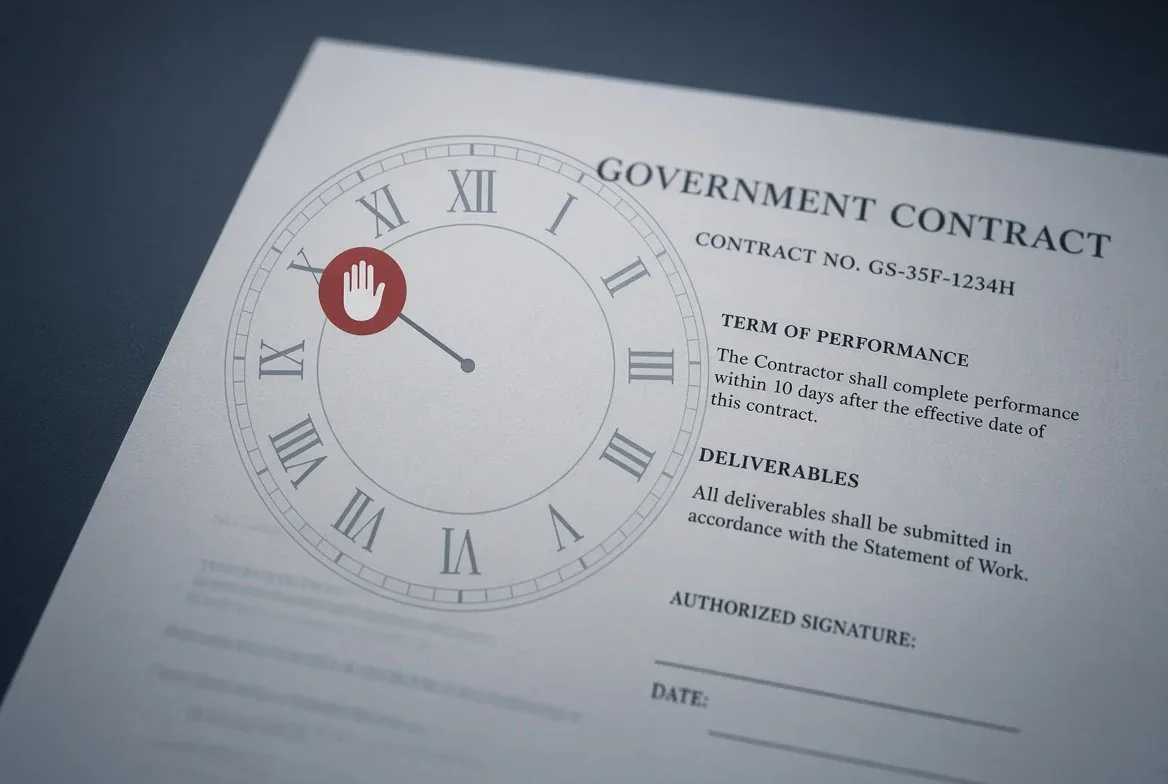
A federal bid protest at the Government Accountability Office runs on a fixed 100-day statutory clock, and the automatic suspension of contract award or performance that kicks in once a timely protest is filed usually matters more to the outcome than the merits of the protest itself. Under 31 U.S.C. § 3554, GAO must issue its decision within 100 days of filing, and under the Competition in Contracting Act's stay provisions, a protest filed within 10 days of award — or 5 days after a required debriefing — freezes the contract in place while GAO works the case.
What actually happens when a protest is filed?
A disappointed bidder files electronically through GAO's Electronic Protest Docketing System, paying a $500 filing fee that took effect October 1, 2024, up from $350 previously. GAO opens a docket, notifies the contracting agency, and the 100-day clock starts running the same day. No attorney is required to file, though most protesters use one given the deadlines involved.
The agency then has 30 days to file an agency report defending the award — the record the contracting officer relied on, the evaluation documents, the source selection decision. The protester gets 10 days after that to file comments responding to the agency's report. GAO's own published timeline shows the case moving from filing toward a decision by day 100, with the agency-report and comment deadlines as the two fixed checkpoints in between.
Why does the automatic stay matter more than the protest itself?
Under FAR 33.104, once an agency receives notice that a protest was filed within 10 days of contract award, or within 5 days after a required debriefing under FAR 15.505 or 15.506 — whichever is later — the contracting officer "shall immediately suspend performance or terminate the awarded contract," with narrow exceptions. Before award, agencies generally cannot proceed at all while a timely protest is pending unless the head of the contracting activity makes a written finding that urgent and compelling circumstances justify moving ahead anyway.
That stay is a lever independent of who eventually wins. A protester who never gets a sustained decision can still freeze an award for weeks simply by filing inside the 10-day or 5-day window — which is why the debriefing date, not the award date, often becomes the fact that determines the whole case.
How does the 10-day filing rule actually work?
Under 4 CFR § 21.2, the general rule is that a protest must be filed no later than 10 days after the protester knew or should have known its basis for protest. Protests over solicitation terms must come before bid opening or the deadline for proposals. Where a debriefing is requested in a competitive negotiated procurement, GAO holds the clock: a protest based on what came out at the debriefing cannot be filed before the debriefing occurs, but must be filed within 10 days of the date the debriefing was held. If a company first protests to the agency itself, it then has 10 days from actual or constructive knowledge of the agency's initial adverse action to bring the same protest to GAO and preserve the automatic stay.
These are not soft guidelines. Missing the window by even a day generally means GAO dismisses the protest as untimely without reaching the merits — a fact that has generated its own body of case law over exactly when a protester "should have known" its basis for protest.
What is the express option, and why does it exist?
For smaller or more straightforward cases, 4 CFR § 21.10 lets GAO use an expedited "express option" track: a 20-day agency report instead of 30, a 5-day comment period, and a final decision within 65 days of filing rather than 100. The tradeoff is compressed briefing time for both sides in exchange for a faster answer — useful for task-order protests and other disputes where a 100-day wait would make the underlying contract moot before GAO ever ruled. GAO decides whether a case qualifies for the express track case by case; a protester cannot simply demand it.
What do the FY 2025 numbers say about how the system is actually working?
GAO's own annual report to Congress puts FY 2025 bid protest filings at 1,688 cases — down 6% from FY 2024's 1,803, continuing an 11% decline the year before; the total docket of 1,737 cases closed that year also included 24 cost claims and 47 requests for reconsideration alongside the 1,617 protests decided or withdrawn. Of the 380 protests GAO decided on the merits that year, 53 were sustained, a 14% sustain rate, down from 16% in FY 2024 and well below FY 2023's 31%. But the more complete measure, GAO's "effectiveness rate" — which counts protests sustained by GAO plus cases where the agency voluntarily took corrective action rather than litigate — held at 52% of all closed protests, roughly matching FY 2024. That gap between a 14% sustain rate and a 52% effectiveness rate is itself a mechanism worth understanding: most relief for protesters comes from agencies choosing to fix a flawed award once a protest is pending and the clock and the stay are both running, not from GAO issuing a formal sustained decision.
What should a contracting officer or a protester watch for?
- The debriefing date, not the award date, usually sets the real deadline once a debriefing is requested under FAR 15.505 or 15.506.
- The automatic stay applies the moment the agency receives timely notice — not when GAO formally dockets the case.
- Day 30 (agency report) and day 40 (protester comments) are the two checkpoints before the day-100 decision on the standard track.
- The express option trades a longer record for a decision in 65 days instead of 100, on GAO's discretion for a case suited to it.
- A dismissal for untimeliness ends the case before the merits are ever reached — the calendar is enforced as strictly as the substance.
None of this determines who should have won a given contract. What it determines is how long a disputed award stays frozen, and that, more than most press releases about a "won" or "lost" protest, is the mechanism agencies and contractors actually plan around.
For a related policy news perspective, read Continuing Resolutions: How Stopgap Funding Actually Works.
For more context, read Rulemaking: How a Federal Rule Actually Gets Made.