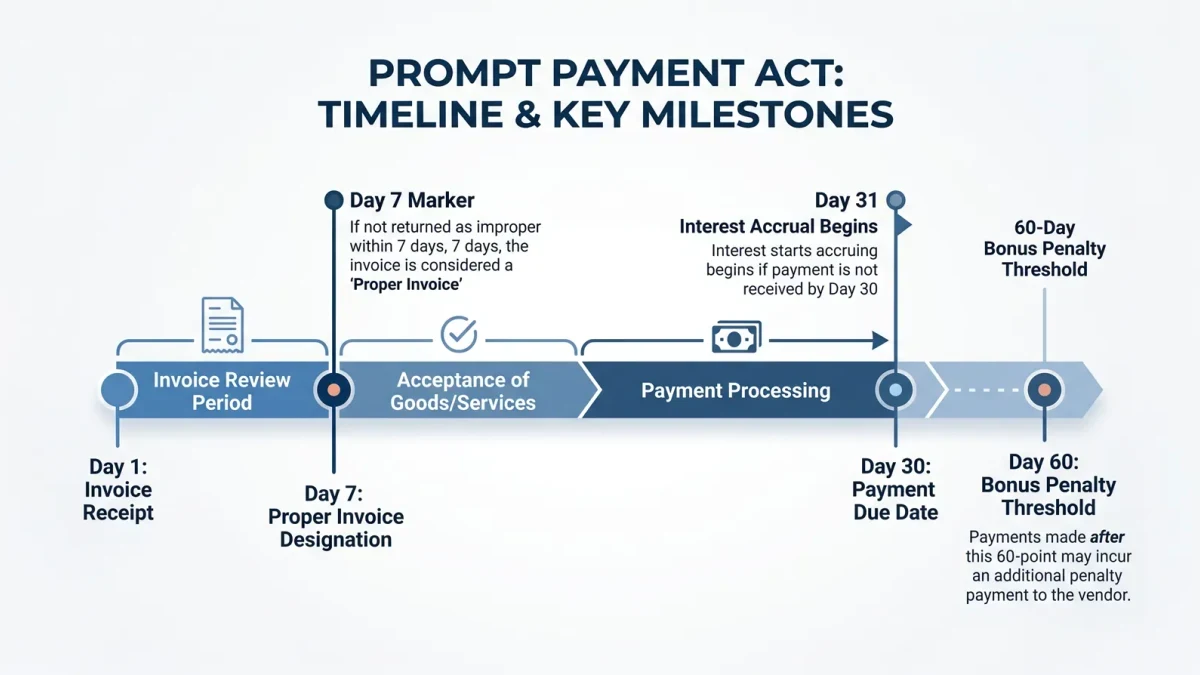
When the federal government buys, it owes money on a statutory clock. The Prompt Payment Act, enacted in 1982 and implemented through Federal Acquisition Regulation clause 52.232-25, generally requires payment of proper invoices within 30 days of receipt — and automatically pays interest penalties when agencies miss, with escalating penalties for longer delays. For a small vendor, the act is one of the few federal payment rules with a self-executing remedy: the interest is owed by operation of the rule, not by lawsuit. But the protections swing on two definitions most vendors learn the hard way: receipt of a proper invoice, and the designated billing office.
How the clock runs
The timeline has stations. The agency designates a billing office in the contract; the vendor submits a proper invoice — one containing everything the contract requires: prices, quantities, shipping numbers, tax identification, and the contract number. The clock starts at receipt of a proper invoice, not at the vendor's sending of a defective one: an invoice missing required content does not start the 30 days, which is how weeks vanish. The agency then has seven days to designate it proper or return it for correction. If the invoice is proper and goods are accepted, payment is due within 30 days; acceptance timing can extend this for goods requiring inspection, and construction contracts run on different progress-payment schedules under the Miller Act framework.
What the penalties add up to
Missing the deadline triggers interest at the rate the Treasury sets periodically — applied at the daily rate from the day after the due date. If payment is more than 60 days late, the penalty structure adds a bonus payment in defined amounts. These amounts are small per invoice, which is precisely the point: the act's leverage is administrative, forcing agencies to track payment timeliness because the Government Accountability Office and agency inspectors general report on payment performance, and chronic lateness surfaces in procurement-system reviews. The documented reality, in GAO payment-management reviews, is dispersion — some agencies pay in a median of two weeks, others carry measurable shares of late payments, and shutdowns and transitions reliably spike the numbers, as after the 43-day lapse of October-November 2025, when invoice queues backed up behind furloughed payment staff.
What vendors should actually do
The craft is procedural. Invoice exactly as the contract specifies, to the designated office, and get receipts — the act's protections are only as good as the record. Track the seven-day proper-invoice designation; if the agency is silent, a documented proper invoice still starts the clock. Ask about the government's electronic invoicing systems — the Invoice Processing Platform and related systems timestamp receipt automatically, removing the disputes. And when interest is owed, request it: agencies can pay Prompt Payment interest on request, and recurring requests surface in the payment-performance statistics that agencies answer for. Subcontractors hold a weaker hand — the act binds the government, not primes — but flow-down clauses and the FAR's subcontractor payment requirements, including the acceleration rules for small-business subs, give primes their own compliance obligations.
FAQ
How long does the government have to pay an invoice?
Generally 30 days from receipt of a proper invoice, with automatic interest penalties thereafter under the Prompt Payment Act and FAR 52.232-25.
When does the 30-day clock start?
On receipt of a proper invoice containing everything the contract requires — a defective invoice does not start the clock, and agencies have seven days to designate or return it.
Do subcontractors get Prompt Payment protection?
Not directly — the act binds the government, but FAR flow-downs and small-business payment rules obligate primes to timely subcontractor payment.