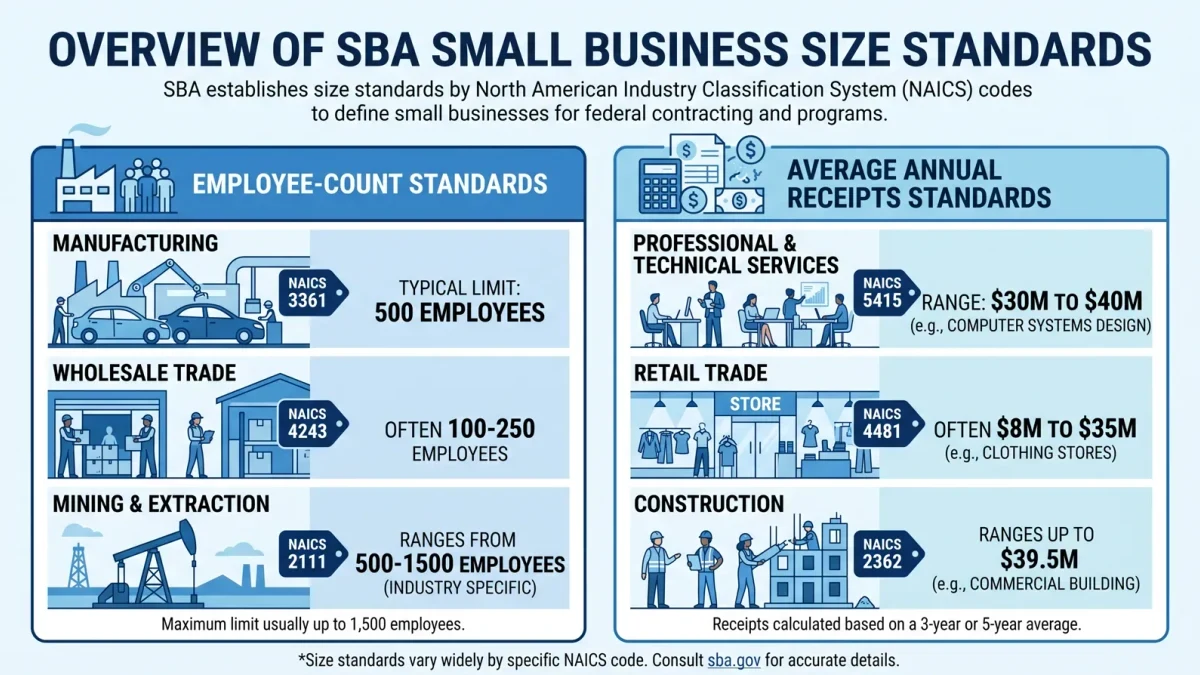
Small-business contracting programs run on a single definitional switch: the Small Business Administration's size standards, which set the employee count or average annual receipts a firm may have and still qualify as small in its industry. Federal agencies have a statutory goal of awarding 23 percent of prime contract dollars to small businesses — a target that has driven more than $150 billion in annual small-business prime awards in recent fiscal years, per Small Business Administration scorecard data — and every set-aside, socioeconomic program, and subcontracting plan keyed to smallness turns on where the line sits. The line is not one line: there are hundreds, one for each North American Industry Classification System code.
How the standards are set
By law, the SBA must review size standards periodically, and the current methodology weights four factors: average firm size within an industry, startup costs and barriers to entry, industry competition structure, and the potential for small firms to compete against large ones — with a fifth, federal contracting impact, considered in some reviews. Most manufacturing and mining industries use employee counts, commonly 500 employees; most service and construction industries use average annual receipts, typically tabulated over five years and ranging from under $8 million to over $40 million depending on the code. A firm's size is determined at the level of its entire business and affiliates — the affiliation rules — not the individual division bidding, which is where most disputes arise.
Why the line keeps moving
Standards rise through a combination of inflation adjustments — periodic across-the-board receipts increases — and analytical reviews that conclude an industry's structure warrants a larger line. Critics, including the Government Accountability Office in reports on small-business contracting, note the countervailing pattern: as standards rise, mid-size firms remain small longer, and the dollars flow to firms far from startup scale, while genuinely tiny firms compete against them inside the same set-asides. The SBA's own data on the distribution of small-business awards shows concentration at the top of the eligible range — the recurring finding behind decades of proposals for a mid-tier category that has never fully materialized.
The affiliation trap, concretely
A firm is small only if it and its affiliates together fit under the standard. Affiliation arises through common ownership or control, joint-venture arrangements, franchise and license dependencies in defined cases, and the ostensible-subcontractor rule — where a small firm is so reliant on a large partner that size passes through to the large firm's scale. Protests over size status go to the SBA's Office of Government Contracting, whose area offices decide them on 15-day clocks; the Government Accountability Office's bid-protest docket shows size questions underlie a steady share of small-business award disputes, and misjudging affiliation is the classic way an award is won and then lost.
FAQ
How does the SBA define a small business?
By industry code: most manufacturing codes cap employees at 500, most service codes cap five-year average annual receipts between roughly $8 million and $40 million — measured with all affiliates included.
What are size standards based on?
SBA's periodic methodology weighing average firm size, entry costs, competition structure, and small-firm competitive potential within each industry.
What is the ostensible subcontractor rule?
The affiliation rule treating a small prime as tied to a large subcontractor on whom it is unusually reliant — passing the large firm's size to the joint bid and voiding small-business eligibility.