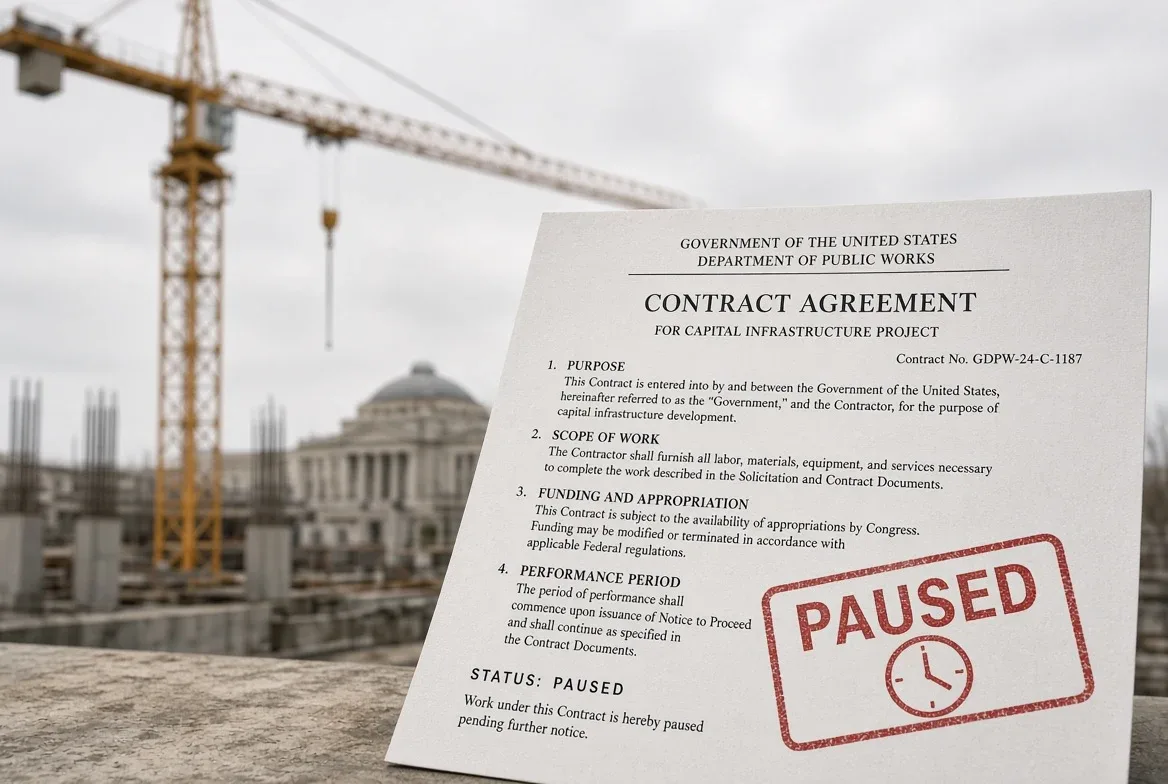
A protest filed with the Government Accountability Office does more than open a review — filed on time, it can stop a federal contract from starting or continuing. Under 31 U.S.C. § 3553, once an agency gets timely notice of a protest, the contracting officer must direct the contractor to cease work, and the freeze holds until GAO rules or an agency head overrides it in writing.
The rule is known in procurement circles as the automatic stay, and it exists because Congress decided in the 1984 Competition in Contracting Act that agencies should not be free to race ahead on a disputed award while a neutral referee sorts out whether the government picked the right bidder. The stay is automatic in the sense that no judge has to order it — it attaches the moment a protest clears two timing tests. Miss either test, and there is no freeze, protest or not.
How does filing a protest trigger the automatic stay?
Timing decides everything. Federal Acquisition Regulation 33.104 sets two separate clocks depending on whether the protest challenges an award that has not yet happened or one that already has. For a pre-award protest, the stay applies if GAO notifies the agency before the deadline set for receipt of proposals, or before contract award if no such deadline applies. For a post-award protest, the stay applies only if the agency receives notice of the protest from GAO within 10 days of contract award, or within 5 days of a debriefing offered under FAR 15.505 or 15.506, whichever comes later.
That second window is why debriefings matter so much to contractors. A losing bidder who waits past the 5-day post-debriefing mark, or past 10 days from award if no debriefing is sought, can still protest — but the contract keeps running while GAO decides. The stay is not a reward for protesting; it is a reward for protesting inside a specific, short calendar window.
What is the 100-day clock, and is there a faster lane?
Once a protest is properly filed, 31 U.S.C. § 3554 requires the Comptroller General to issue a final decision within 100 days of the date the protest was submitted. GAO also runs an express option for cases it determines are suitable for faster resolution, with a target of 65 days from submission. Protest amendments that add new grounds are supposed to be resolved within the original 100-day window where practical; if that is not feasible, GAO can route the amended protest into the 65-day express track instead.
Agencies, for their part, are required to file a complete report responding to the protest within 30 days of receiving notice, unless GAO grants more time for good cause. In its fiscal year 2025 annual report to Congress, GAO said it issued final decisions within the 100-day deadline for all protests filed that year — a compliance record the office has maintained even as protest volume has shifted year to year.
When can an agency override the stay?
The freeze is not absolute. Both 31 U.S.C. § 3553 and FAR 33.104 give the head of the procuring activity two narrow paths to keep a contract moving despite a timely protest, and both require a written finding, made on a nondelegable basis, with notice to the Comptroller General before performance resumes.
- Best-interests finding: the activity head determines that continued contract performance is in the best interests of the United States.
- Urgency finding: the activity head determines that urgent and compelling circumstances significantly affecting U.S. interests will not permit waiting for GAO's decision.
Neither override is self-executing. FAR 33.104 requires the finding in writing and requires the agency to notify GAO before work resumes, which means the override itself becomes part of the public protest record — not a quiet workaround.
What happens once GAO decides?
Most protests do not end in a sustain. GAO's fiscal year 2025 report put the sustain rate — protests decided on the merits and found valid — at 14%, down from 16% the prior year and well below fiscal year 2023's 31%. A broader measure, the effectiveness rate, counts any protest that produced some form of relief for the protester, including cases an agency voluntarily corrects before GAO rules; that rate stood at 52% of closed protests in fiscal year 2025.
The three most common grounds for a sustained protest, per the same report, were an unreasonable technical evaluation, an unreasonable cost or price evaluation, and an unreasonable rejection of a proposal. GAO also reported that alternative dispute resolution, used to settle protests without a full written decision, succeeded in 91% of the cases where it was attempted, and that formal hearings remained rare — three cases, or 0.5% of the year's docket.
The protest timeline, step by step
| Stage | Deadline | Source |
|---|---|---|
| Post-award notice needed to trigger stay | 10 days after award, or 5 days after a required debriefing, whichever is later | FAR 33.104 |
| Agency protest report due to GAO | 30 days after receiving protest notice | 31 U.S.C. § 3554 |
| Standard GAO decision deadline | 100 days after the protest is submitted | 31 U.S.C. § 3554 |
| Express-option decision target | 65 days after the protest is submitted, at GAO's discretion | 31 U.S.C. § 3554 |
| Agency compliance report if recommendations not implemented | 5 days after a 60-day implementation window expires | FAR 33.104 |
The mechanism rewards precision over persistence. A contractor that misses the 10-day or 5-day trigger can still protest and still win — GAO's merits review does not depend on the stay — but the government keeps building the thing it may later have to unwind. That asymmetry, more than any single statistic in GAO's annual report, is what shapes how quickly a losing bidder's counsel moves once a debriefing ends.
What if GAO dismisses the protest instead of deciding it?
Not every protest reaches a merits decision inside the 100-day window. Under 31 U.S.C. § 3554, the Comptroller General retains authority to dismiss a protest outright if it is frivolous or if, on its face, it fails to state a valid basis for protest — a threshold screen that keeps the sustain-rate and effectiveness-rate figures from applying to every case filed. GAO's fiscal year 2025 report also credits its alternative dispute resolution process, used to resolve disputes without a full written decision, with a 91% success rate in the cases where it was attempted, and notes that formal hearings — the most resource-intensive step in the process — were held in only three cases, or 0.5% of the year's docket. Both figures point to the same operational reality: the automatic stay is designed to be short-lived by default, resolved through paper review and negotiated correction far more often than through adversarial hearings.
The agency compliance mechanism works the same way. If an agency does not fully implement a GAO recommendation within 60 days, FAR 33.104 requires the head of the contracting activity to report that failure to GAO within 5 days of the 60-day window closing. That reporting requirement is what turns a GAO recommendation — which is not self-enforcing in the way a court order is — into a matter of public record if an agency declines to follow it.
For a related policy perspective, read Bid Protests: How the 100-Day Clock Actually Works.