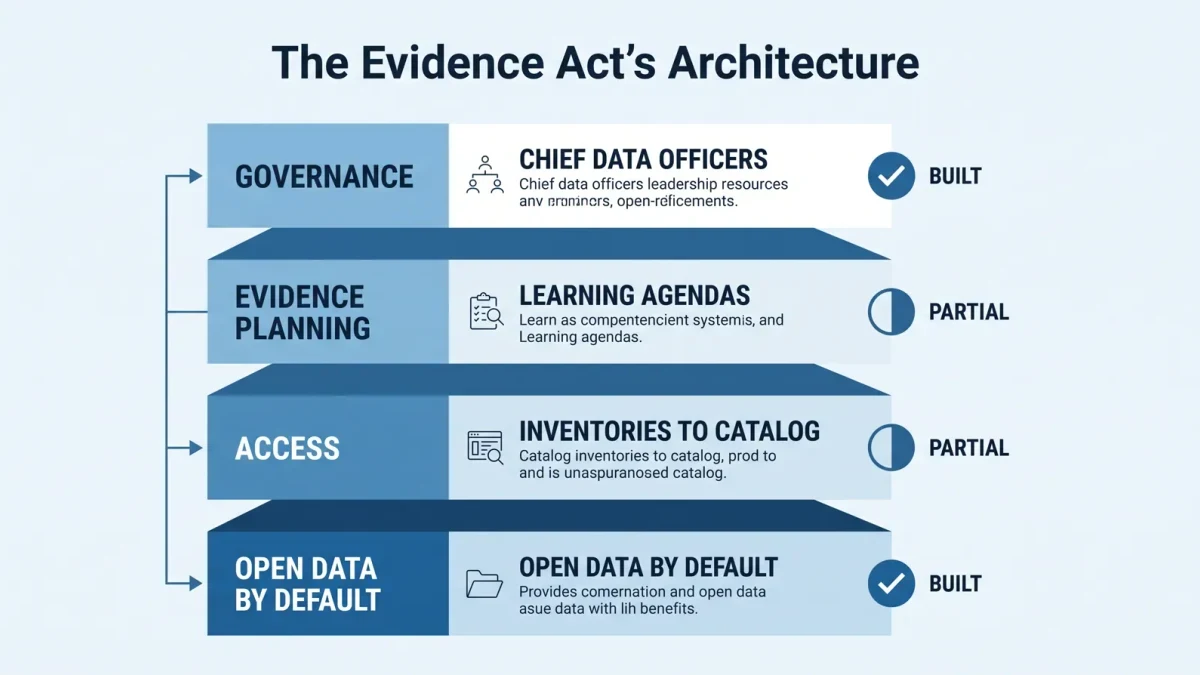
The Foundations for Evidence-Based Policymaking Act of 2018 is the least visible major government-management law of its era, and its report card is mixed in an instructive way. The statute ordered four things: every agency to name a chief data officer and a evaluation officer; annual learning agendas linking priority questions to data; comprehensive data inventories feeding the public catalog; and open data by default under Title II, the OPEN Government Data Act. Seven years in, the Government Accountability Office's implementation reviews show the machinery built — chief data officers exist across agencies, learning agendas are published, inventories are filed — and the familiar gap between compliance and function: inventories of uneven quality, evaluation capacity thin relative to mandate, and data-quality problems that the statute assumed someone would fix and no one was funded to.
What actually got built
Three layers of infrastructure now exist that did not in 2018. Governance: chief data officers with a statutory charter and a federal council coordinating across agencies, institutionalizing a role that had been a series of experiments. An evidence-planning layer: learning agendas that force agencies to state, publicly, what questions they most need answered — a discipline the GPRA era never imposed — and annual evaluation plans reporting what studies were done. An access layer: the inventory-to-catalog pipeline and expanded interagency data-sharing under Title III's confidentiality protections, which gives researchers lawful paths to administrative data that previously required bespoke legal negotiation. Each layer is auditable, and the GAO audits them.
Where it stalls
The stalls are structural, and the reviews name them. Data quality upstream: inventories list datasets whose contents are stale or undocumented, because the act requires listing, not stewardship — the same gap that limits open data generally. Evaluation capacity: evaluation offices were mandated without dedicated appropriations, so the function is staffed by reassignment in many agencies, and annual evaluation plans describe aspirations as often as studies. And the political economy of evidence: learning agendas identify what agencies want to know; nothing requires the answers to change budget decisions, which returns to performance-based budgeting's old finding — information enters hearings, not allocations. The act's own design anticipated this weakly; its champions argued infrastructure-first, consequences-later, and the later has not arrived.
Why it still counts
The honest assessment is that the Evidence Act built the plumbing a serious evidence system would need, on the bet that plumbing outlasts patience. The precedents support modest optimism: the GPRA infrastructure, dismissed in its first decade as paperwork, became the reporting backbone that later reforms and oversight bodies actually use; the Data Act's transparency reporting, despite rocky implementation per GAO, now produces standardized award data that was structurally impossible before. Evidence-Act assets are already load-bearing in specific places — administrative-data research collaborations, agency data-strategy work, the chief data officer community's shared practices — and the 2025-26 reorganization era makes them more valuable, not less: agencies that know what data they hold merge and modernize better than agencies that do not.
FAQ
What is the Evidence Act?
The Foundations for Evidence-Based Policymaking Act of 2018 — mandating chief data and evaluation officers, learning agendas, data inventories, and open-by-default publication across federal agencies.
Has it worked?
Infrastructure yes: officers, agendas, inventories, and access channels exist and are audited; function is partial, with uneven data quality and underfunded evaluation capacity per GAO reviews.
Does evidence change budgets?
Rarely by itself — the act builds supply; connecting answers to allocations remains the unpassed reform performance-budgeting evaluations keep identifying.