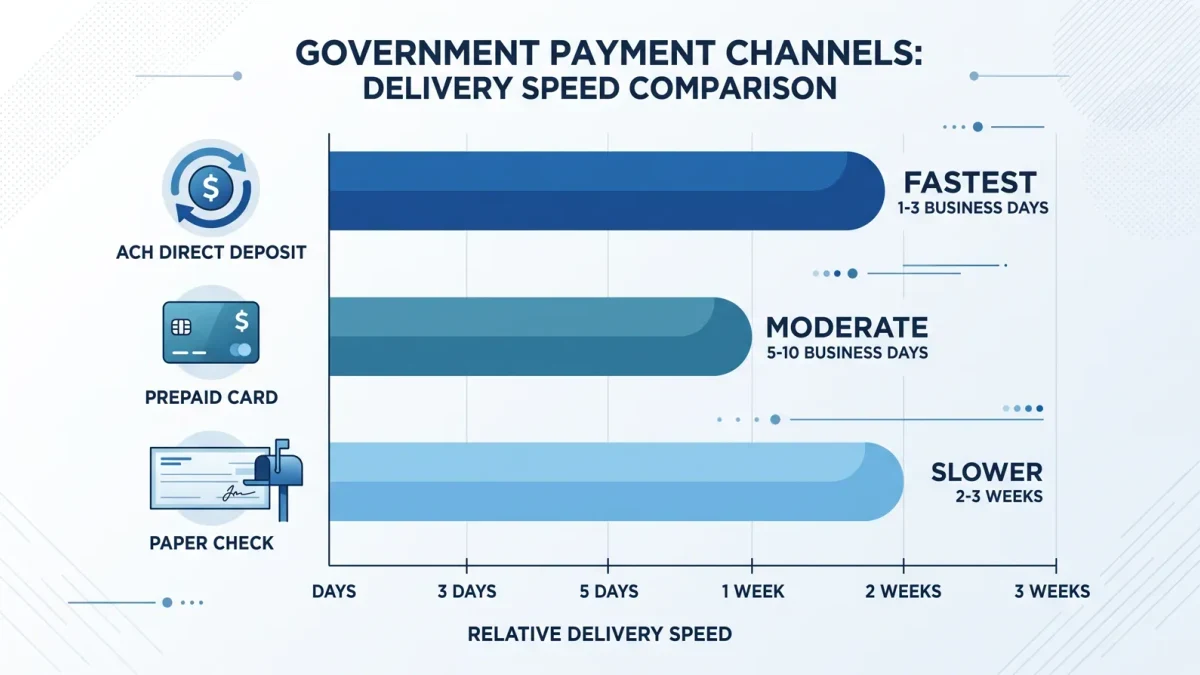
When government pays people, the money moves through one of several channels, and the channel determines the speed. Routine benefits — Social Security, veterans compensation, Supplemental Nutrition Assistance — flow on scheduled cycles through the Automated Clearing House network, the batch system that settles U.S. direct deposits in one to two business days. Emergency payments historically moved slower: paper checks, then prepaid debit cards, with pandemic-era relief exposing the gap — stimulus payments and unemployment insurance topped up accounts within days for taxpayers with current direct-deposit information on file, while filers without banking data on record waited weeks for paper and prepaid-card disbursement, a delay documented in Government Accountability Office and Pandemic Response Accountability Committee reporting. Modernizing benefits delivery has meant shrinking exactly that gap.
Why the routine rails are reliable
Scheduled benefits work because everything about them is predictable. The Social Security Administration knows the amount, the payee, the date, and the account months ahead; ACH volume is batched and pre-scheduled; and the Treasury's payment machinery — including its do-not-pay data matching against debt and deceased records, mandated by the Do Not Pay Initiative — runs against known schedules. Reliability here is a property of predictability, not of technology sophistication. The same ACH moves an emergency payment just as fast once the recipient's data is clean; the bottleneck upstream of the rail is eligibility determination and identity, which is where emergency programs actually lose their days.
What changed after the pandemic
Three durable changes. First, the Internal Revenue Service's role as the de facto emergency-payment platform: repeated rounds of economic-impact payments trained the system to reach most households in days via tax-file direct-deposit data, and child tax credit advance payments in 2021 ran monthly through the same channel. Second, Treasury's adoption of instant-payment capability — the Federal Reserve's FedNow service, launched in 2023, gives banks a real-time rail, and Treasury pilots for same-day government disbursement build on it. Third, fraud controls got teeth and costs: unemployment-insurance fraud during the pandemic, with improper payments estimated in the tens of billions nationally by GAO and state auditors, pushed states into identity-proofing and data-matching requirements that trade speed for verification — the central tension in benefits technology today.
The unbanked problem, quantified
Direct deposit requires an account, and the Federal Deposit Insurance Corporation's household surveys have consistently found millions of U.S. households unbanked, concentrated among lower-income, younger, and minority households — the population emergency programs most need to reach. The workaround stack: prepaid cards issued by programs, Treasury's Direct Express card for federal benefits, and Treasury's EIP card program for stimulus payments, each slower to load and costlier per transaction than ACH. Municipal and postal-banking proposals target the same gap. The Government Accountability Office's evaluations of EIP delivery found the delay concentrated exactly among card and paper recipients — the modernization case in one sentence: the rail is fast, the last mile is not.
What to watch
Two indicators tell you whether a benefits program can deliver in a crisis: what share of its recipient file carries current direct-deposit data, and whether it has tested same-day disbursement against its payment processor. Programs that publish those two numbers can be held to them; programs that do not are guessing, and the next emergency will do the auditing.
FAQ
How fast are government benefit payments?
Scheduled benefits via ACH direct deposit typically settle in one to two business days; emergency payments historically took weeks for recipients without banking data on file, though IRS-based delivery cut that to days for most households.
What is FedNow?
The Federal Reserve's instant-payment service launched in 2023, giving banks a real-time rail that Treasury pilots use toward same-day government disbursement.
Why do unbanked recipients wait longer?
Without an account, payments go by paper check or prepaid card — slower to issue, slower to load, and costlier per transaction than direct deposit.