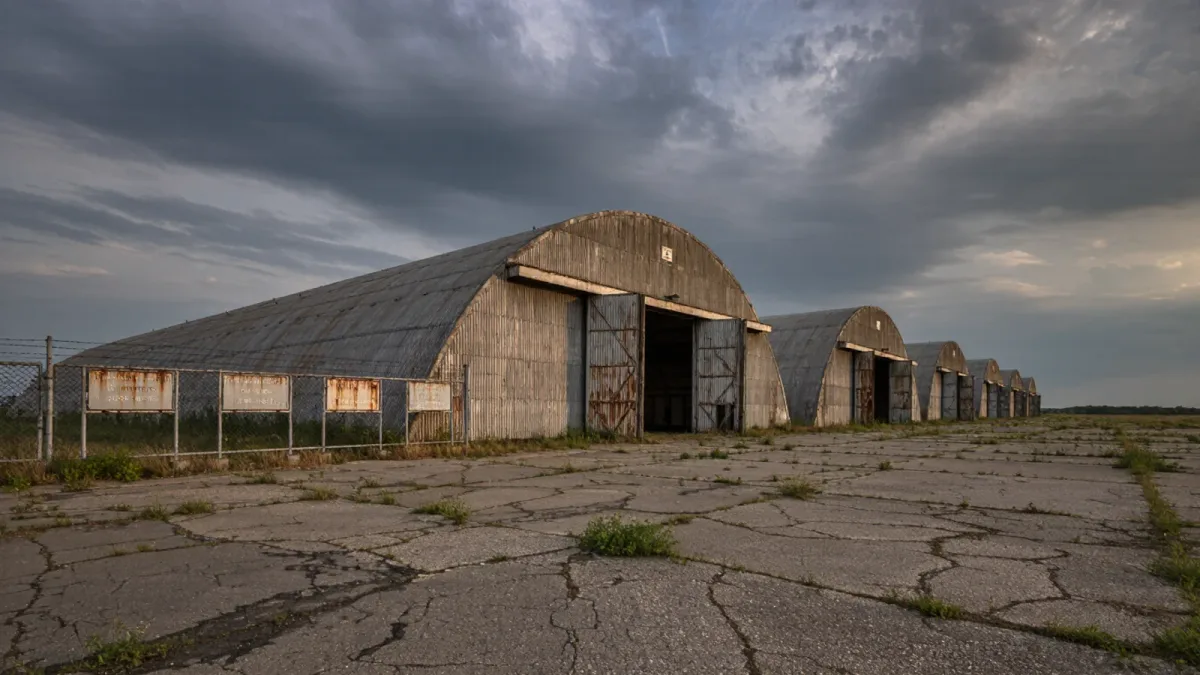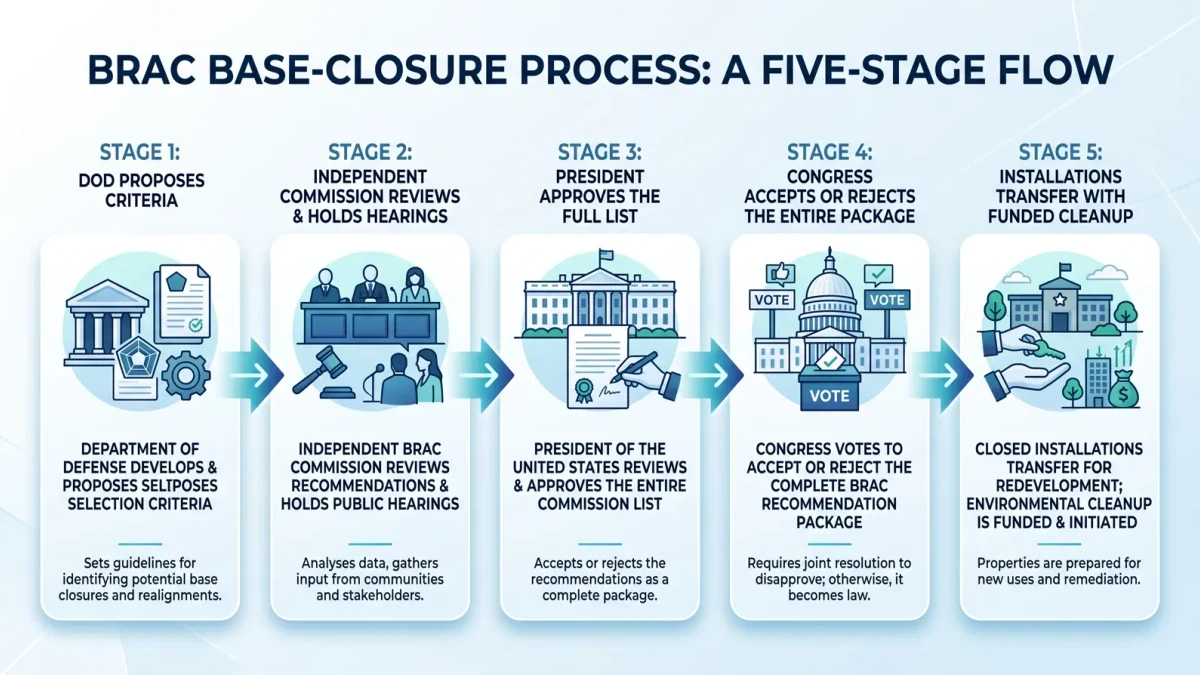
Between 1989 and 2005, five independent base-closure commissions recommended shutting or realigning hundreds of military installations, and Congress implemented nearly every recommendation — a record no other federal consolidation matches. The Base Realignment and Closure mechanism worked because of one design choice: an independent commission proposed a complete list, Congress had to accept or reject it in whole by law, and individual members never got to vote on their own district's base. The Government Accountability Office's retrospective reviews documented roughly $7 billion a year in recurring savings by the early 2000s from the first four rounds, against substantial up-front closure and environmental-remediation costs that took years to work through.
How the BRAC process actually ran
Each round followed a statutory sequence. The Department of Defense proposed selection criteria and a force-structure plan; an independent commission of presidential appointees held public hearings and could modify the list, as the 1995 and 2005 commissions notably did; the President had to approve or reject the list in full; and Congress then had roughly 45 legislative days to disapprove the entire package by joint resolution — otherwise every closure became law simultaneously. Communities had a formal appeal channel through the commission hearings, and environmental cleanup and property transfer obligations were funded through a dedicated account, which mattered because the savings arrived years after the checks were written.
Why it worked where ordinary reorganization fails
The design neutralized the collective-action problem. Every member of Congress wants waste closed in principle and nothing closed in their district in practice; voting base by base means nothing ever closes. BRAC bundled the pain — every state got some of it — and made the default passage rather than inaction. The GAO's evaluations credit two further features: published, consistent selection criteria, which made the commission's choices defensible in hearings and in court when communities sued; and the dedicated cleanup funding, which prevented the accounting from hiding the transition bill inside future defense budgets.
Why no BRAC round has happened since 2005
The 2005 round is the cautionary tale that froze the model. Departing from earlier rounds, it weighted military transformation value heavily and produced net up-front costs the GAO tracked well past 2010 — the first round where the commission's own estimates drew sustained congressional skepticism, and projected savings arrived far later than promised. The Pentagon requested new BRAC authority repeatedly through the 2010s and early 2020s; Congress declined each time, and communities organized against future rounds on the economic-dependence argument. The tool works only when Congress pre-commits to the rules, and after 2005 Congress stopped pre-committing.
What transfers — and what does not
Non-defense reformers cite BRAC for closure of field offices, data centers, and civilian facilities, and two elements genuinely transfer: the bundled take-it-or-leave-it package, and published selection criteria applied identically across jurisdictions. What does not transfer is the legal simplicity. Bases are executive-branch property; most civilian infrastructure carries statutory offices, labor agreements, and community dependencies that no commission can bundle away. A civil-service BRAC would need Congress to pre-authorize the bundle in statute — which is precisely the vote BRAC exists to avoid asking members to take twice.
FAQ
What does BRAC stand for?
Base Realignment and Closure — the statutory process used in five rounds from 1989 to 2005 to close and consolidate U.S. military installations through independent commissions.
How much money did BRAC save?
GAO reported roughly $7 billion per year in recurring savings from the first four rounds, offset in the 2005 round by large up-front closure and environmental-remediation costs.
Could a BRAC-style commission work outside defense?
The bundling and criteria transfer; the legal path does not, because civilian facilities carry statutory offices and labor commitments a commission cannot waive without new legislation.