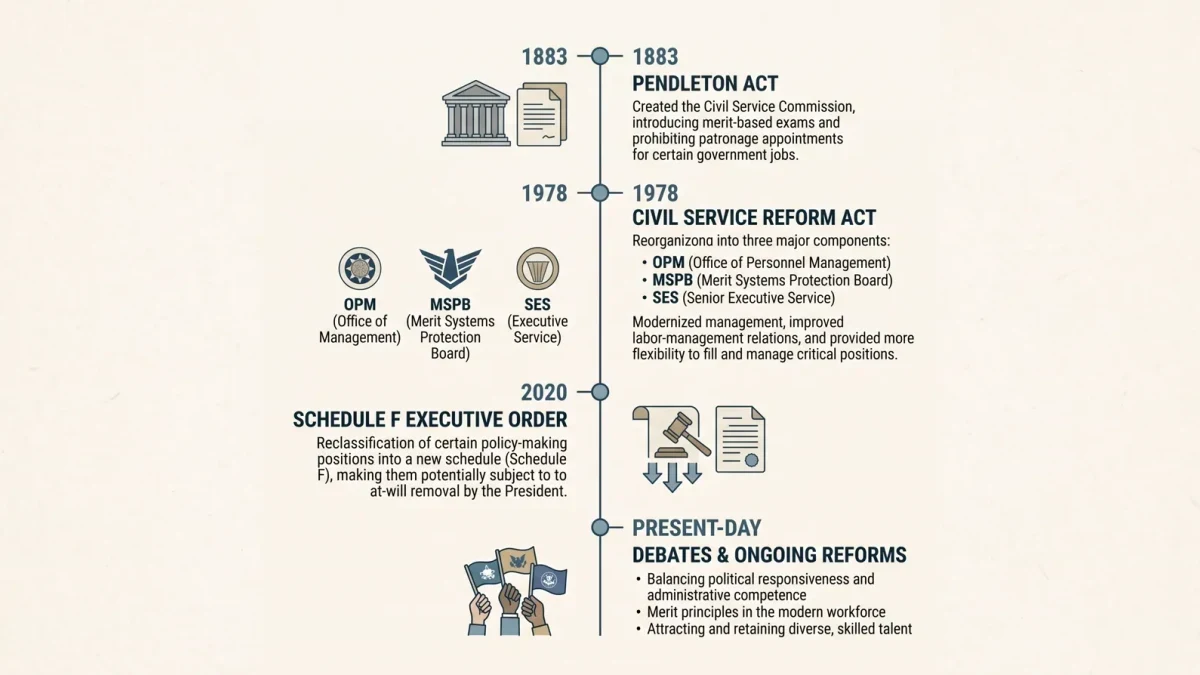
American civil service reform began with an assassination. After President Garfield was shot in 1881 by a disappointed office-seeker, Congress passed the Pendleton Civil Service Reform Act of 1883, which created a merit system — competitive examinations, protection from removal for political reasons — initially covering about ten percent of federal jobs. Coverage grew to roughly half the service by 1900 and the broad competitive service followed. The durable design principle, articulated in the act and reinforced by the 1978 Civil Service Reform Act that created the Senior Executive Service and the Office of Personnel Management, is a trade: employees accept below-market pay ceilings and public accountability, and receive job security, due process, and political neutrality in exchange. Every serious reform fight since — including the Schedule F controversy of 2020 and its successors — is an argument about where that trade should sit, not whether it exists.
What Pendleton actually changed
Before 1883, federal employment turned over with each presidency — the spoils system, whose administration costs and corruption motivated reformers. Pendleton's three mechanisms remain the skeleton of today's system: open competitive examinations administered by a Civil Service Commission, the ancestor of today's OPM; prohibition of political tests, assessments, and coercion in hiring; and insulation of covered employees from politically motivated removal. The act did not create lifetime tenure — that developed through subsequent statutes and case law, culminating in the adverse-action and appeals framework now codified in Title 5. What it created was a professional class whose loyalty ran to the office rather than the officeholder.
The 1978 settlement, and why it still defines the terms
The Civil Service Reform Act of 1978 was the last full renegotiation. It split the Civil Service Commission into OPM and the Merit Systems Protection Board, created the Office of Special Counsel to police prohibited personnel practices, and established the Senior Executive Service — a corps of executives expected to move between agencies and share presidential priorities while retaining appeal protections. It also legitimized performance management: reductions-in-force based partly on performance ratings, and demonstration authority for agencies to test alternative personnel systems. The 1978 logic was explicit: protect the process, not every position, and create a senior layer where responsiveness to elected leadership is part of the job description.
The modern fight over that seam
The Schedule F episode of 2020 — an executive order creating a new excepted-service category for policy-relevant positions, revoked in 2021 and re-contested since — and the subsequent legislative proposals to shrink competitive-service protections all target the same boundary Pendleton drew: how many positions carry full due process, and how many serve at the administration's discretion. Proponents of reclassification argue the SES model proved responsiveness and merit can coexist; opponents, pointing to the history of the spoils era documented by the U.S. Office of Personnel Management's own historical accounts and by scholars of the patronage system, argue that removing protections re-creates the coercion Pendleton abolished. The empirical question — whether performance improves when protections fall — has produced no clean answer; the Government Accountability Office's federal hiring reviews attribute government's skills problems chiefly to hiring speed and pay competitiveness, not to removal difficulty.
What history says reforms need
The reforms that lasted shared three properties. They changed the process, not just the personnel: Pendleton built exams, 1978 built the MSPB and SES. They were bipartisan settlements, because a merit system survives only if both parties prefer it to the alternative. And they addressed a scandal or visible failure that made the status quo indefensible. Reforms without those three — quick reclassifications by executive order alone, or protections expanded without process redesign — have historically been reversed by the next administration, which is itself a lesson about durability.
FAQ
What was the Pendleton Act?
The 1883 law that replaced the spoils system with merit-based, exam-tested federal employment and barred political coercion in hiring — the foundation of today's civil service.
What did the 1978 Civil Service Reform Act do?
It created OPM, the Merit Systems Protection Board, the Office of Special Counsel, and the Senior Executive Service, and tied reductions-in-force partly to performance.
What is the Schedule F debate about?
Whether policy-influencing federal positions should carry full competitive-service due-process protections or serve with fewer protections closer to at-will — the modern renegotiation of Pendleton's line.