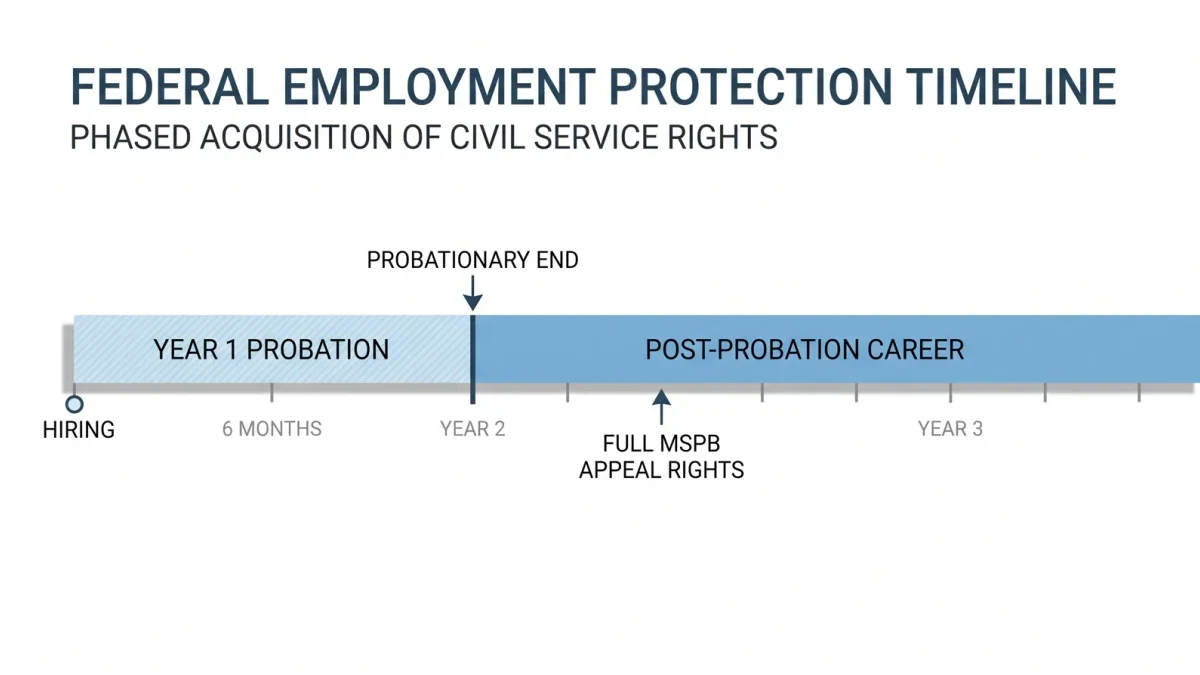
Probationary status is the least understood lever in federal workforce policy. New federal employees in the competitive serve a probationary period of one year under 5 CFR 315, and new supervisors serve an additional one-year supervisory probation under 5 CFR 315.903 — but appointees moving from other federal service, and many excepted-service hires, face different clocks entirely. During probation, an employee can be separated with notice but without the formal adverse-action apparatus that protects career staff after conversion. That asymmetry is why probationary periods became the focal point of workforce-reduction debates in 2025: they are the cheapest legal channel for separating people.
What protections disappear during probation?
A career employee who has completed probation cannot be removed for performance or conduct without due process: written notice, an opportunity to reply, and appeal rights that run to the Merit Systems Protection Board. A probationary employee has none of that in full. Under the regulation, an agency can terminate a probationer for pre-employment reasons with no procedure at all, or for post-appointment reasons with a written notice and an effective date — no reply opportunity, no MSPB appeal as of right. The system is designed as an extended job interview, and it behaves like one.
The exception that matters: probationers fired for partisan reasons or because they disclosed wrongdoing can still reach the Office of Special Counsel, and whistleblower protections under 5 U.S.C. 2302 apply from day one. Probation trims procedural rights, not statutory ones.
How does a reduction in force differ?
A reduction in force is the other separation mechanism, and it operates on completed careers, not probationers. Under 5 CFR 351, a RIF uses retention registers: employees are ranked by tenure group, veterans' preference, length of service, and performance ratings, and the agency releases from the bottom. Employees facing RIF get notice periods — generally 60 days for competitive-service positions — reassignment rights to vacant positions they can qualify for, and appeal rights to the MSPB. A RIF is slower, more documented, and more contestable than a probationary separation, which is exactly why agencies under pressure to shrink quickly reach for the probationary channel first.
Why do agencies use deferred resignation instead?
Deferred-resignation offers — pay and benefits for a fixed period in exchange for a commitment to leave — sit outside both mechanisms. They are faster than a RIF, less litigable than mass probationary terminations, and voluntary on paper. The tradeoff is fiscal: every month of paid administrative leave is salary without output, and agencies have no claw-back if workload returns. The mechanics resemble the 2020-era Voluntary Early Retirement Authority and Voluntary Separation Incentive Payments toolkit in OPM's FEDSCOPE guidance, which likewise traded immediate payroll savings for exit incentives and, in some occupations, skill gaps documented later by agency inspectors general.
What should readers watch?
Three indicators tell you whether a workforce reduction is procedurally durable. First, the mix: how many separations run through probation, how many through resignation offers, how many through RIF. Second, the notice: RIF notices and probationary terminations are document streams that courts and the MSPB can later audit. Third, the staffing floors: positions exempted because they are statutorily required — air traffic control, food inspection, benefits processing — reveal where the reduction actually stops.
FAQ
How long is the federal probationary period?
One year for most new competitive-service employees, with an additional supervisory probation year for new supervisors. Excepted-service schedules and transfers run on different rules, which is why cohort counts vary by agency.
Can a probationary employee appeal a termination?
Not through the standard adverse-action appeal to the MSPB. Protections against prohibited personnel practices and retaliation for whistleblowing still apply from the first day of employment.
What is a retention register in a RIF?
The ranked list an agency builds under 5 CFR 351 that orders who is released first, based on tenure, veterans' preference, service length, and performance ratings.