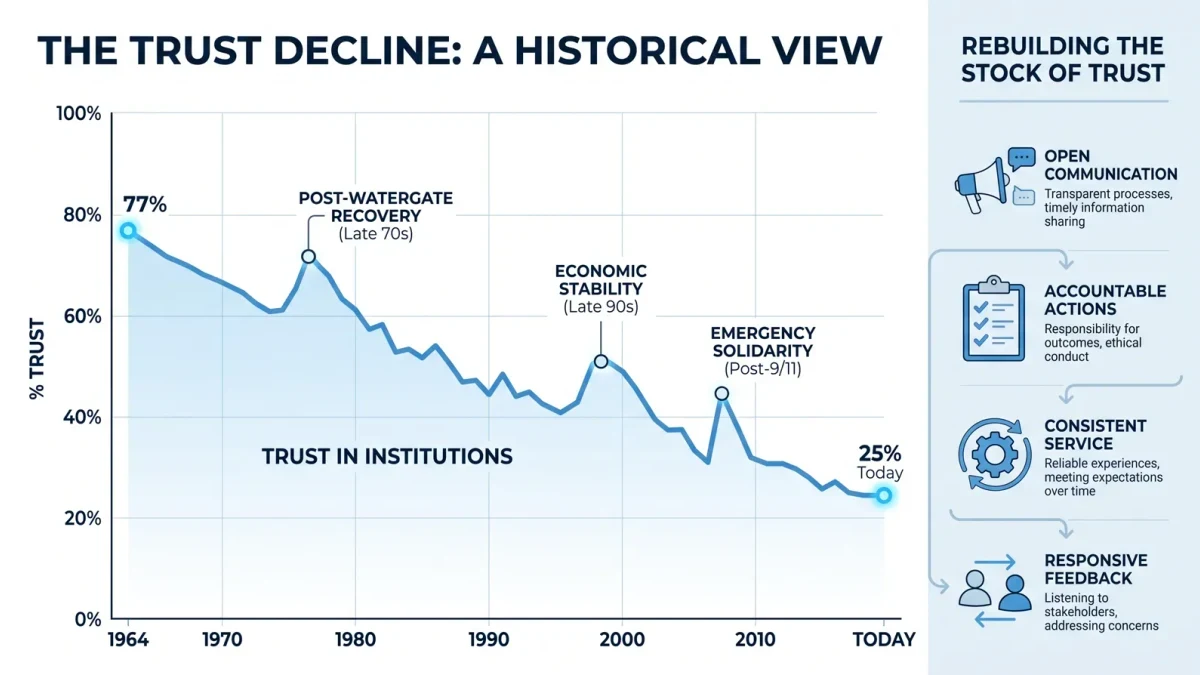
The Pew Research Center's trust series, the field's benchmark, has tracked the share of Americans who trust the federal government to do what is right always or most of the time from 77 percent in 1964 to below 25 percent in recent years — a decline crossing administrations of both parties, punctuated by partial recoveries in the late 1980s and early 2000s and deepening in every crisis since. The measurement itself deserves scrutiny before the interpretation: trust questions are sensitive to wording and to the day's news, aggregate answers mask huge partisan asymmetries — trust swings by tens of points depending on which party holds the presidency — and the decline is a long slide, not an event.
What the correlates actually show
The research literature, from political science to the behavioral work summarized in Organisation for Economic Co-operation and Development trust frameworks, sorts candidate causes. Partisan and affective polarization is the strongest proximate correlate: out-party presidencies tank in-party-trusters' scores. Economic conditions matter: sentiment-trackers co-move with personal financial outlook. Scandal cycles leave marks that outlast the scandals. And the most actionable finding, from behavioral work on citizen-state interactions: service experience drives institutional trust directly — people who get competent, respectful treatment from a government service update their general trust, and people who get runarounds do too. This is the finding behind the service-delivery school of trust repair, and it is the one government can actually operate.
Why messaging fails and service compounds
Trust campaigns — speeches, rebrands, transparency portals — have a documented habit of disappointing, and the reason is the mismatch: they target the aggregate attitude, which is polarized and slow, while trust is experienced locally, one interaction at a time. The compounding insight cuts both ways. Each clean transaction — a benefits claim processed on time, a permit issued without mystery, a 311 request actually closed — deposits a small amount of generalized trust; each broken one withdraws more, per service research on loss asymmetry. A government that processes a million service interactions a day is running a million trust experiments whether it intends to or not, which is why shutdowns, benefit delays, and website failures matter beyond their direct costs: they are trust events at scale. The record 43-day lapse of October-November 2025 — pay frozen for hundreds of thousands, services suspended nationwide — is the recent textbook case.
What has demonstrably helped
The interventions with evidence share a shape: fix a specific service, measure satisfaction, repeat. Tax filing simplified — the direct-file pilots and pre-populated returns research — raises satisfaction among users regardless of politics. Benefits modernization that shortens wait times moves satisfaction scores measurably. Recovery from specific breakdowns, when handled transparently — published backlogs, honest timelines — recovers trust faster than the initial failure lost it. None of this moves the Pew number next quarter; the number is a stock, the service a flow. But the flow is the only lever government holds that compounds.
FAQ
How is trust in government measured?
Chiefly through survey series like Pew's — the share trusting Washington to do what is right always or most of the time — complemented by OECD frameworks tracking satisfaction with specific services.
What causes the decline in trust?
Polarization is the strongest correlate, with economic sentiment and scandal cycles contributing; no single event explains a six-decade slide across both parties' administrations.
Can government rebuild trust?
Evidence points to service experience: competent, timely, respectful transactions measurably raise institutional trust — messaging alone does not.