In Loper Bright Enterprises v. Raimondo, decided June 28, 2024, the Supreme Court overruled Chevron deference, ending the forty-year practice of courts deferring to agency interpretations of ambiguous statutes. The constitutional allocation the Court invoked — that ambiguity belongs to judges, not agencies — shifted the interpretive battleground from agency rulemaking preambles to judicial construction. Two years on, the practice effects are legible in how agencies draft, how challengers litigate, and how Congress legislates, and they compound the already-cautious drafting environment created by the record Congressional Review Act year of 2025.
What changed, mechanically
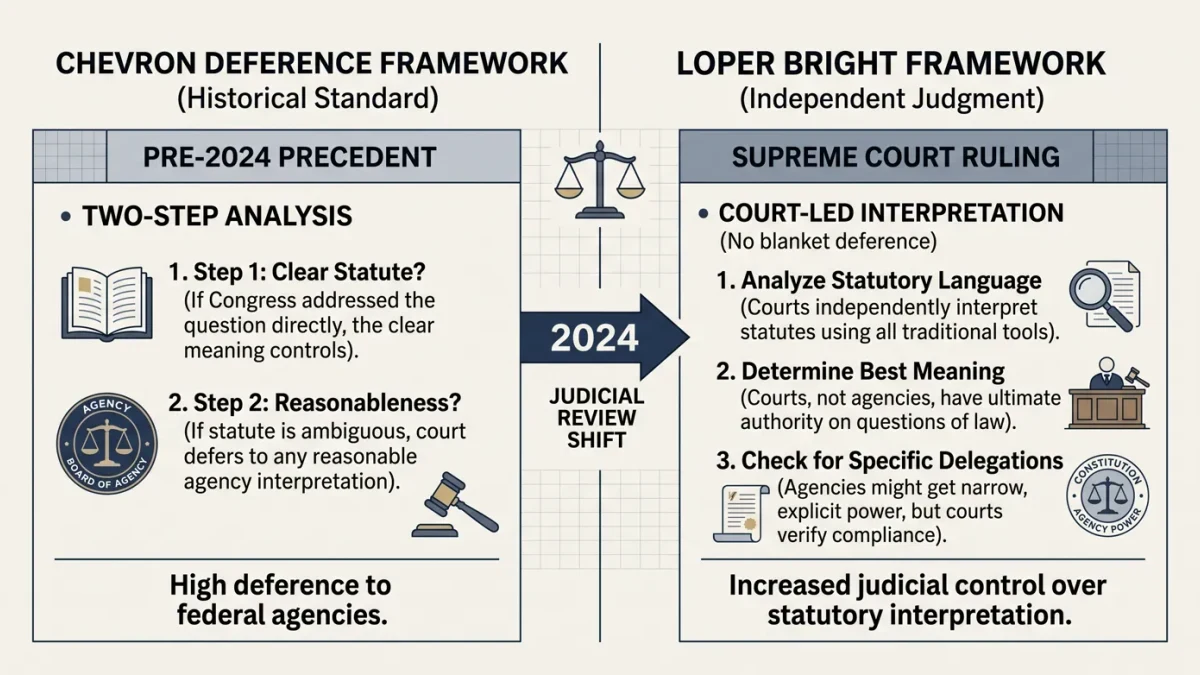
Under Chevron, an agency reading a statute it administers won if the statute was ambiguous and the reading was reasonable — a two-step test that made rulemaking preambles persuasive documents in court. After Loper Bright, courts exercise independent judgment on statutory meaning, informed by but not bound by agency views. The decision expressly preserved the weight of agency expertise in the sense that Skidmore respect — persuasion by the quality of an agency's reasoning — remains, and it did not disturb delegation of policymaking discretion where Congress has actually granted it. What disappeared is the tie going to the agency: ambiguous terms now get judicially constructed meanings, and a rule resting on a debatable reading is vulnerable regardless of its reasonableness.
The drafting response
Three changes in rulemaking practice recur across agencies and are consistent with what regulatory commentators and the Government Accountability Office's rulemaking reviews describe. Longer, more explicit statutory grounding: preambles now trace each operative provision to specific statutory text, quoting rather than paraphrasing, because the citation is the defense. Reliance on clear delegations: agencies favor exercising authority where Congress spoke directly — numeric standards the statute prescribes, registration and reporting schemes — and defer contested interpretive moves to notice-and-comment with robust records. And statutory-interpretation methodology in the record: rules now cite legislative history, canons of construction, and corpus-style usage evidence more frequently, importing the tools of judicial construction into agency documents.
The litigation response
Challengers read the same map. Post-Loper Bright briefs lead with statutory meaning rather than arbitrary-and-capricious arguments, because a clean textual victory voids the rule outright. The major-questions doctrine — under which courts refuse to read sweeping authority into vague statutes, reinforced by West Virginia v. EPA in 2022 — operates as Loper Bright's escalator, and the combination has narrowed the space for ambitious regulatory initiatives irrespective of administration. The volume effects are visible: contested-rule litigation timelines have not shortened, but win rates for agencies on statutory challenges have compressed, per early empirical studies of post-2024 circuit decisions.
What it means for the rulebook's future
The durable consequence is legislative, not judicial. When ambiguity is resolved by courts rather than agencies, every unresolved statutory term becomes a standing invitation to litigation, and Congress faces pressure to write more specific statutes — which it does slowly. In the interim, the operative advice for reading any new rule is simple: find the statutory sentence the rule claims as its authority, and ask whether that sentence plainly says what the rule does. If not, the rule's lifespan is set by the first sympathetic courtroom, not the Federal Register.
FAQ
What did Loper Bright change?
It overruled Chevron deference: courts no longer defer to agency readings of ambiguous statutes and instead exercise independent judgment, leaving agencies only the persuasive weight of their reasoning.
Can agencies still interpret statutes they administer?
Yes — their interpretations still carry Skidmore persuasive weight and delegated discretion still binds where Congress granted it; what ended was the tie-breaker in favor of agencies on ambiguity.
What is the major questions doctrine?
The principle that courts will not read vast economic and political significance into vague statutory grants — reinforced in 2022 and now functioning alongside Loper Bright to narrow ambitious rulemaking.