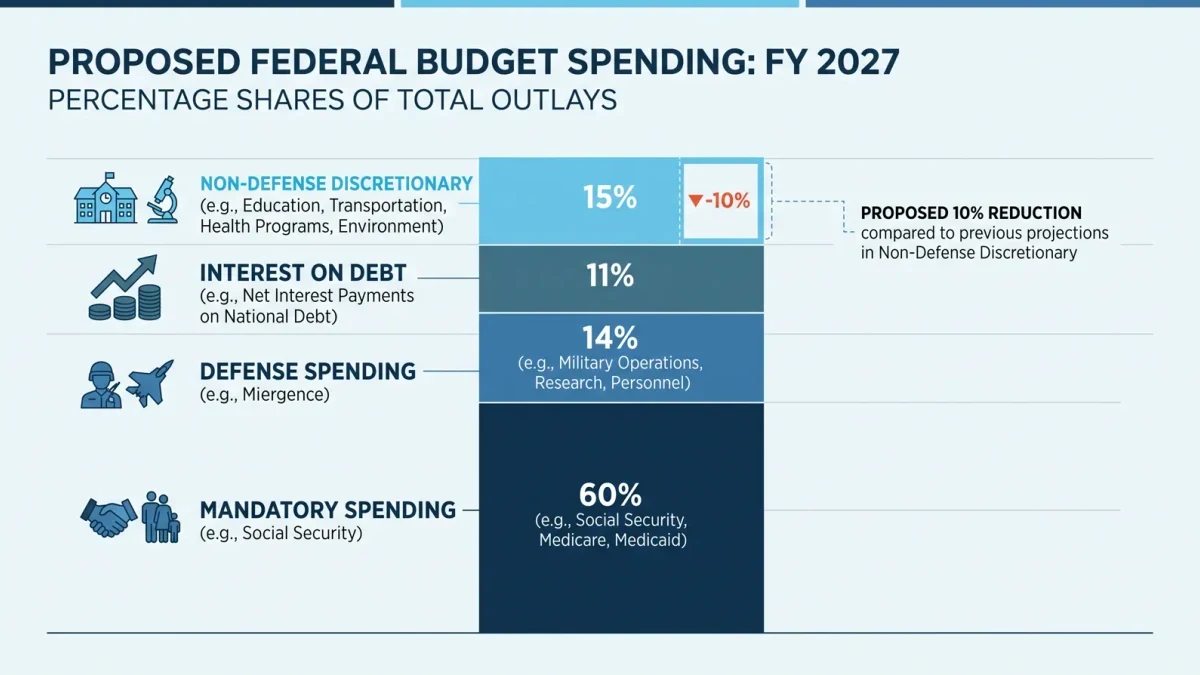
The administration's budget request for fiscal 2027, released in partial form the week of March 30, 2026 after missing its February 2 statutory deadline, proposes a 10 percent cut to non-defense discretionary spending — roughly $73 billion below fiscal 2026 enacted levels, per analyses from the National Association of Counties and the Center on Budget and Policy Priorities. The request arrived partial, covering a subset of agencies in detail, with the remainder of the justification books to follow — a structure budget-watchers know well, and one that shifts the fight to the appropriations subcommittees, where the twelve annual bills must translate the topline into line items.
What the number means in practice
A 10 percent non-defense reduction lands unevenly by construction. Non-defense discretionary spending — the annually appropriated slice covering medical research, air-traffic operations, food inspection, grants to states and counties, housing assistance and the federal civilian workforce — is roughly a quarter of the budget, so a cut of this scale does not move the deficit dramatically; the Congressional Budget Office's 2026-2036 outlook projects deficits near $1.9 trillion driven chiefly by mandatory programs and interest. What the cut does move is service capacity: county-government analyses, like NACo's, track the pass-through programs — infrastructure, housing, health — where federal discretionary dollars fund local delivery, and those are the line items where a 10 percent topline cut becomes a visible service decision.
What happens to the request now
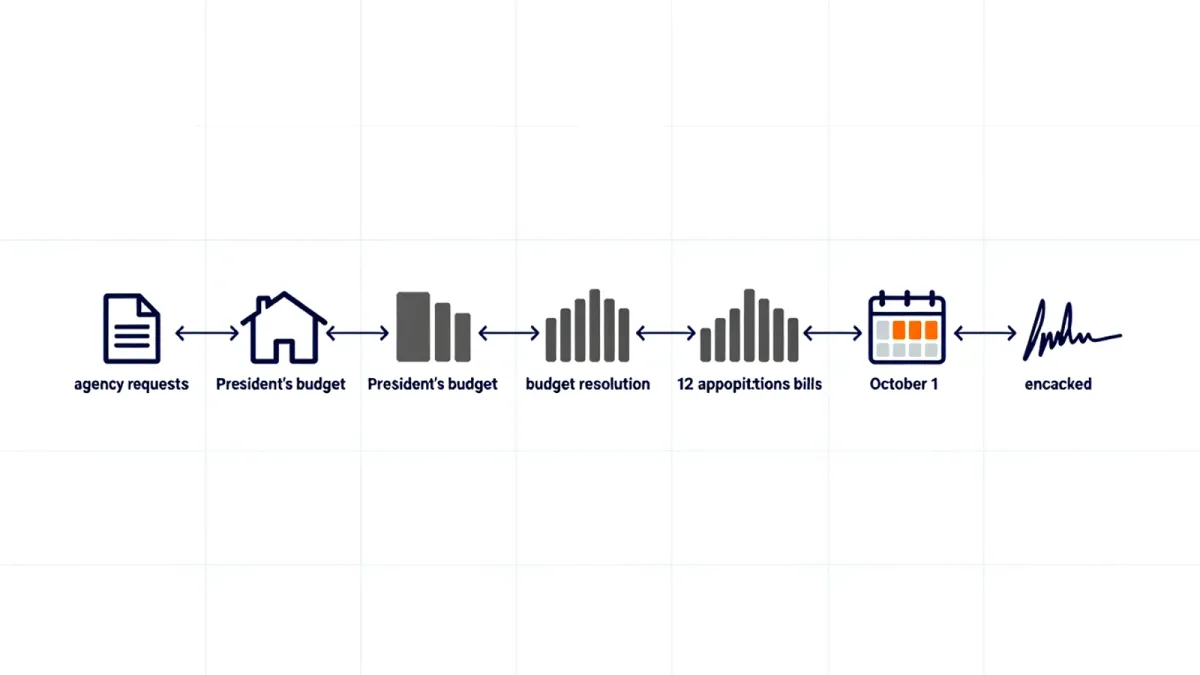
The sequence is mechanical. The House and Senate Budget Committees may take up a budget resolution setting topline levels — due April 15 by statute, rarely on time — and the appropriations committees allocate the topline across twelve suballocations, the 302(b) levels, which cap each bill. A request this far below what Senate appropriators of either party have historically accepted sets up the familiar resolution: the topline rises in negotiation, or the year ends under continuing resolutions. The recent baseline is instructive — fiscal 2026 began with a record 43-day lapse from October 1 to November 12, 2025, resolved by a stopgap into late January, and continuing resolutions have carried a large share of recent fiscal years.
What to watch in the markup season
Three checkpoints will tell you whether this request becomes law in any recognizable form. The 302(b) suballocations, usually late spring, reveal whether appropriators accepted the 10 percent topline at all. The first House markup in June shows which committee chairs protect which accounts — the standard pattern is bipartisan protection for medical research, veterans' medical care where applicable, and aviation safety. And the fiscal-year end on September 30, 2026: if the twelve bills are not done — and full-year omnibus passage in an election-adjacent year is rare — the request's real-world effect is whatever the continuing resolution preserves at prior-year levels.
FAQ
What does the FY2027 budget request propose?
A 10 percent cut to non-defense discretionary spending, about $73 billion below fiscal 2026 levels, released in partial form the week of March 30, 2026.
Does a discretionary cut shrink the deficit much?
Not dramatically — non-defense discretionary spending is roughly a quarter of the budget, while CBO projects near $1.9 trillion deficits driven mainly by mandatory programs and interest costs.
What are 302(b) allocations?
The suballocations by which the appropriations committees divide the total discretionary topline among the twelve annual spending bills — the first hard test of any President's request.